
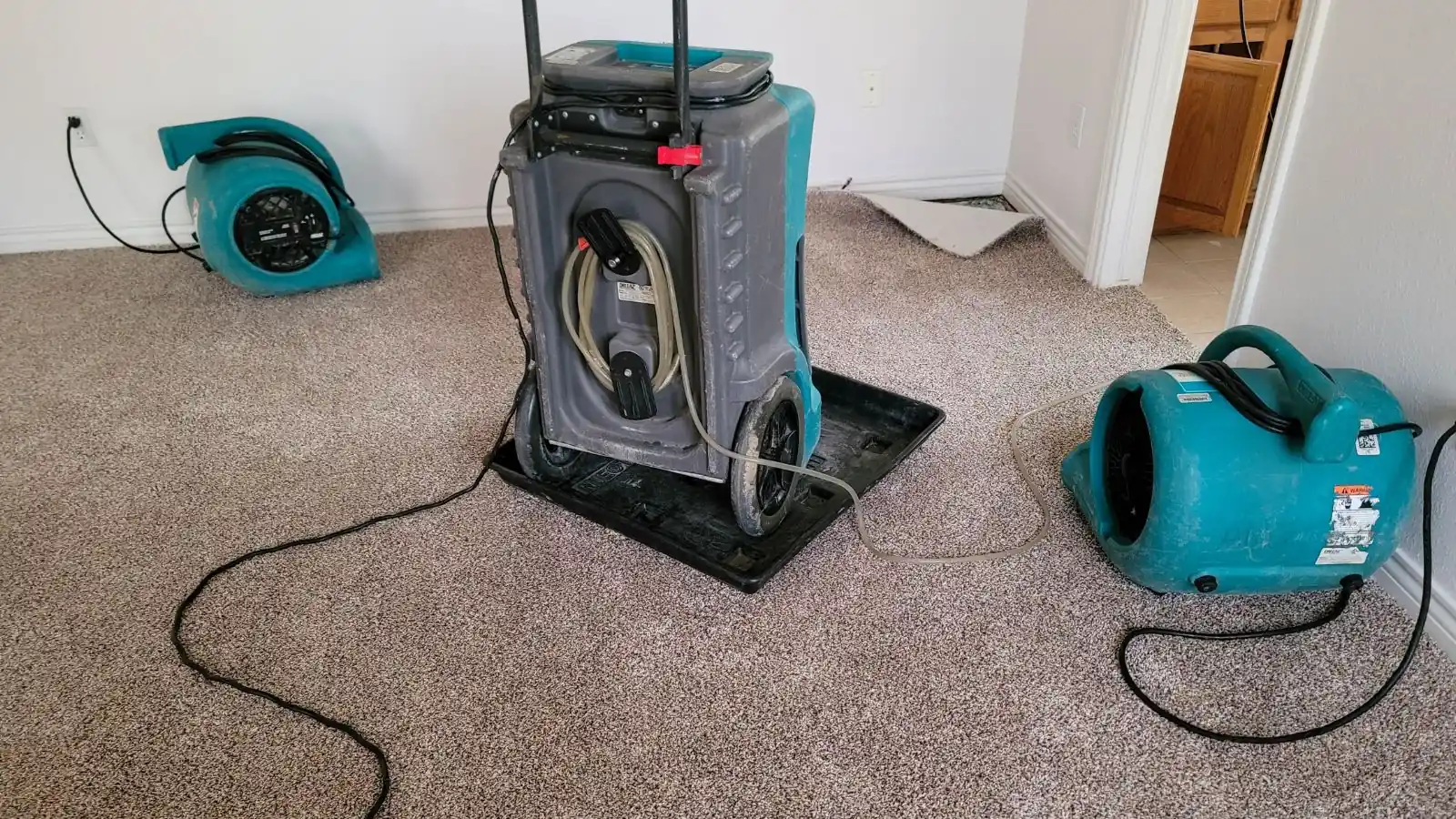
Most water damage in a house takes about 3 to 5 days to dry when professional equipment runs continuously, but the range is wide. Carpet and drywall are often dry in that window, framing can take a week, and hardwood floors and concrete can take weeks. The only reliable end point is a moisture reading that matches a dry reference, not the calendar.
Typical drying times by material
These ranges assume the water is clean, the source is stopped, standing water has been extracted and drying equipment starts within the first day or two. They are typical, not promises, and a thick or saturated material can take much longer.
| Material | Typical range | Notes |
|---|---|---|
| Carpet (surface) | 2 to 4 days | The pad is often removed because it dries slowly and traps contamination |
| Drywall | 3 to 5 days | Badly soaked or sagging drywall is often cut out instead of dried |
| Insulation in walls | Often removed | Wet batts hold water and lose their value, so they are usually replaced |
| Wood framing and subfloor | 4 to 7 days | Thicker lumber dries more slowly from the center |
| Hardwood flooring | 1 to 4 weeks or more | Dries slowly and may cup, so floors are often dried in place with mats |
| Plaster | 1 to 3 weeks | Dense material that releases water slowly |
| Concrete slab or block | Several weeks | Dry gradually, and the slab surface can read dry while the core stays damp |
Safety checks while drying equipment runs
- Do not run household fans at wet insulation or walls without checking the water category first, because they can spread contaminated moisture.
- Keep people and pets out of rooms with running air movers and cords crossing wet floors.
- Never bypass a tripped breaker to power drying equipment. Ask the crew to use dry circuits.
- Call your utility or 911 first if water has reached a panel, outlet or gas appliance.
Is the drying taking longer than it should? Call the dispatch line and describe what the readings show.
Call (516) 845-9582What changes the timeline
Time before drying starts is the largest factor. Water that sits for a day soaks further into framing and flooring, and after 48 to 72 hours materials begin to degrade and mold can start to grow. Starting within the first day shortens everything that follows.
Water category matters too. ANSI/IICRC S500 groups water into three categories, and Category 2 and 3 usually mean removing porous materials like carpet pad and wet drywall instead of drying them, which changes the schedule. See flood damage restoration for how flood water changes the plan.
- Class of the loss: how much of the room and how deep into materials the water went
- Material density and thickness, from thin carpet to a solid hardwood plank or a 4-inch slab
- Humidity and temperature indoors and outdoors, since air must be drier than the material to pull water out
- Airflow and equipment placement, including the number of air movers and dehumidifiers
- Hidden pockets, such as wet insulation, cabinet toe-kicks and wall cavities that block airflow
- Whether the building is occupied and whether the heating or cooling can stay on
Drying goals: how a crew knows it is finished
A drying goal is a target moisture reading for each material, set by measuring the same material in an unaffected area of your house. If the interior wall in the next room reads a certain value, the wet wall is dry when it reads close to it. ANSI/IICRC S500 is the published industry standard for this approach, and you can ask any company whether its crews follow it.
Without a goal, nobody can tell whether a wall is dry. A surface can feel dry while wet material remains deeper inside. That is why a goal and a written record matter more than how many fans are running.
How monitoring works day by day
A crew starts by mapping moisture with moisture meters and a thermal imaging camera, marking wet areas and noting the temperature and humidity. Then it places air movers to push air across surfaces and LGR or desiccant dehumidifiers to remove water from the air. The goal is to keep the air dry enough to draw moisture out of materials.
Each day the crew returns, takes the same readings at the same marked spots and compares them with the dry reference. Equipment is moved or removed as areas reach their goals. Details of the process are in structural drying and dehumidification, and standing water is handled first under water extraction.
Floors and walls that take the longest
Solid and engineered wood floors absorb water slowly and release it slowly. Cupping, where the edges rise, can appear in days, and some floors flatten as they dry while others stay warped and need replacement. Specialized drying mats can speed this up. See hardwood floor water damage repair for the decision points.
Wall cavities dry slowly because air does not circulate behind drywall. A crew may drill small holes or remove baseboards to push air in. For soaked boards or insulation, wall and drywall water damage repair explains when removal beats drying.
When to worry
Be concerned if readings stop falling for a full day while the equipment keeps running. That plateau suggests a hidden source, a wet pocket or a humidity problem. Also watch for a sour smell after the third or fourth day, floors that keep cupping, indoor humidity that will not drop below about 60 percent and visible spotting on walls or ceilings.
Visible mold growth is a separate project. New York requires licensed professionals for mold projects over 10 square feet, and the assessor and remediator must be different. See mold remediation, and take health questions to a physician.
What drives the cost of a longer job
Longer drying means more days of equipment, more monitoring visits and often more rebuild work. The water category, the area affected, the materials and the number of drying days all shape the price. Ask for a written scope and an explanation of the drying goals before work starts.
Ask your insurer how your policy treats sudden and accidental water, since gradual leaks and flood are often excluded. New York's Department of Financial Services advises documenting damage before cleanup and filing as soon as possible. Keep the drying logs, because they show what was wet and when it dried.
Limits of any drying estimate
Nobody can give an exact drying time before the job begins, because hidden moisture changes the picture. An honest estimate is a range with a reason, and a good company revises it with readings.
Drying does not repair the cause. A failed pipe, roof or foundation crack still needs a plumber, roofer or contractor. To see where we dispatch, check our service area page.
What Seaford homeowners should check locally
The National Weather Service's Freeport impacts sheet records canal overflows in Seaford during Hurricane Irene in August 2011. Canal and bay water is treated as Category 3, so expect porous materials to be removed first and drying to start only after that. Photograph everything before cleanup starts.
The NWS flash flood warning for southeastern Nassau County in August 2024 described rain rates of 1 to 3 inches per hour. If a downpour like that sends water into your lower level, remove standing water quickly and call early, because every hour of delay lengthens drying.
Nassau County's hazard mitigation plan rates flooding as Highly Likely. Check the FEMA flood map for your address and ask your insurer about flood coverage, since New York's Department of Financial Services says a typical homeowners policy excludes it.
Frequently asked questions
How long does it take for a wet floor to dry?
Carpet may dry in 2 to 4 days with fans and a dehumidifier, while hardwood can take 1 to 4 weeks or more. A concrete slab can take several weeks. The surface can feel dry long before the material is, so readings decide when it is done.
Why do the drying machines run for days?
Water in wood, drywall and concrete leaves slowly, and only when the air around it is drier than the material. Air movers and dehumidifiers run until readings match your dry reference. Shutting them early leaves moisture inside walls and floors.
Can I speed up drying with space heaters?
Gentle warmth helps, but space heaters alone are a poor and risky approach. Dehumidifiers and airflow remove the moisture. Heating wet materials without removing the humidity just moves water into the air, where it settles on cooler surfaces.
How do I know my walls are really dry?
A crew compares readings at marked spots against a dry reference wall of the same material, and records each day. Ask to see the logs. If you only rely on how a wall feels, wet insulation or framing can stay hidden.
What if there is still a musty smell after drying?
It means some material is still damp or a growth source remains. Ask for a moisture re-check behind baseboards, under flooring and in cabinets. If you see mold covering more than 10 square feet, New York requires licensed mold professionals.
Does a flooded Seaford basement take longer to dry?
Often, yes. Canal and bay water is Category 3, so porous materials are removed before drying begins, and concrete block walls hold water. The NWS recorded canal overflows in Seaford during Hurricane Irene. Document the loss, remove standing water and expect a longer schedule.
If a room still feels damp after several days, call the 24/7 line and ask for a moisture re-check.
Call (516) 845-9582