
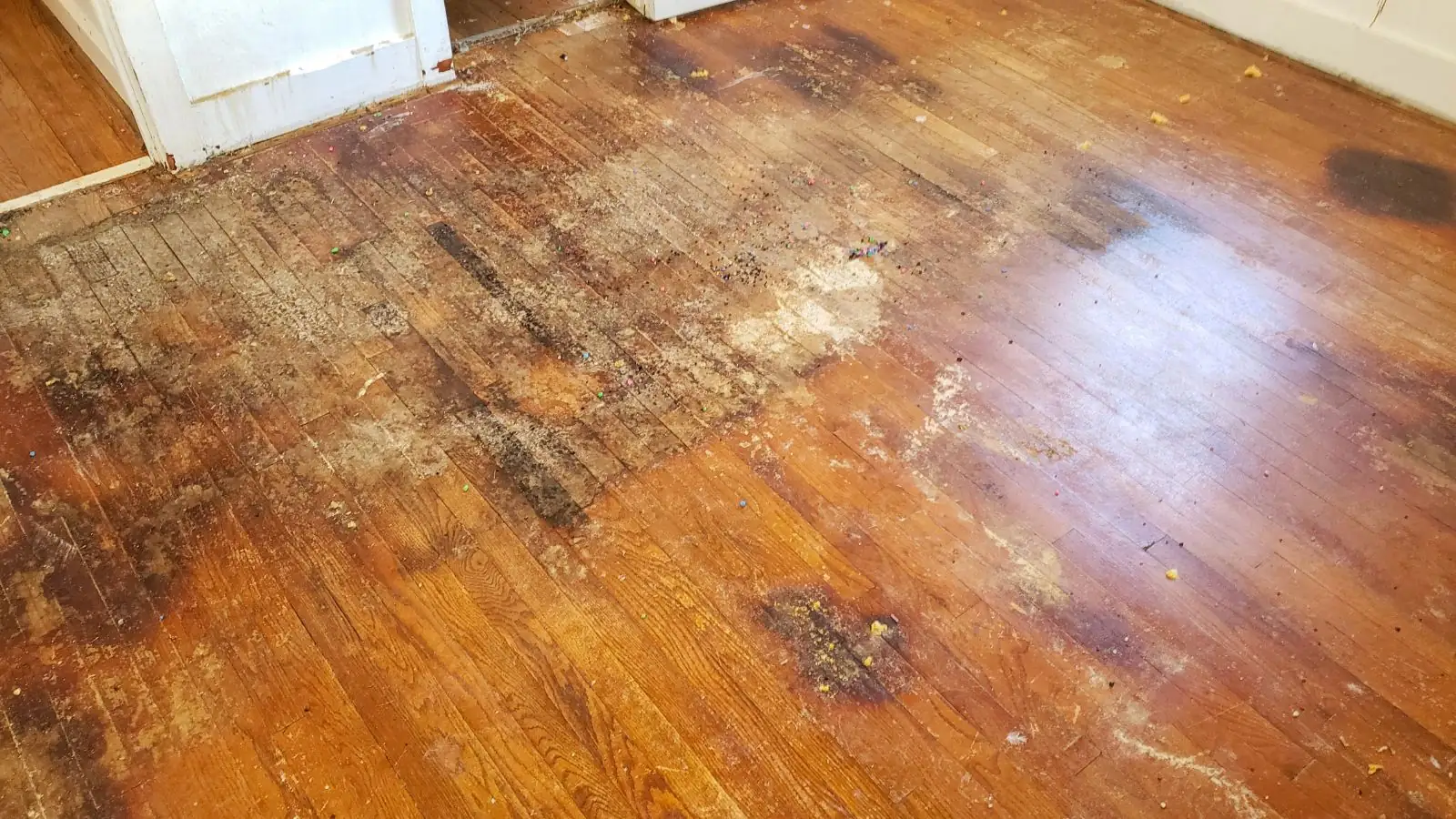
Hardwood floor water damage repair is the work of drying wet wood or laminate flooring and the subfloor under it, then sanding, patching or replacing boards that cannot return to flat. If your floor in Seaford, NY has started to cup, gap or lift after a leak, the clock matters more than the cleanup. Wood takes on water through its underside and edges, so the top can look fine while the boards swell below.
While you wait for a call back, stop the source of the water if you can, lift rugs and furniture legs off the floor, and keep foot traffic to a minimum. Do not run a household heater at the boards, because fast heat can crack them. Open interior doors so air can move, and photograph the damage for your insurer.
What a water-damaged wood floor looks and feels like
The first sign is usually at the board edges. They turn up slightly, so each plank looks like a shallow tray, and the floor catches light in stripes. Run your hand across it and you can feel ridges where the seams used to be flush.
Other signs show up over a few days. Gaps open between boards as the wood dries and shrinks, a dull or white haze appears in the finish, and dark stains grow near nail holes. A musty smell from the floor line means moisture is still trapped below. Laminate behaves differently, with swollen, chipped seams that do not flatten once dry.
- Cupping: edges higher than the centre of each board
- Crowning: the centre higher than the edges, often after sanding a cupped floor too soon
- Buckling: boards lifting off the subfloor in a ridge, a sign of heavy water
- Dark gray or black staining, which points to long wet exposure
- Soft spots or bounce, which point to subfloor damage
Why wood floors cup after a leak
Wood is hygroscopic, meaning it absorbs and releases moisture until it matches the air and surfaces around it. When the underside of a board gets wetter than the top, the bottom swells faster and the edges curl up. That is cupping, and it is the most common damage we see on flooring over a damp subfloor, a leaking dishwasher line, or a wet crawl space.
Annual precipitation at the nearest long-record NOAA station, Islip MacArthur Airport, averages about 46 inches. Long Island homes take on humidity and groundwater moisture all year, so if your floor sits over a basement or a crawl space, have the area below checked for dampness as well as the boards themselves.
Raised edges, a hollow sound underfoot, or a damp smell from the floor? Call and we will explain the drying plan and the scope before work starts.
Call (516) 845-9582Cupping, crowning and buckling: what each one tells us
Cupping is the stage where recovery is most likely. The boards are swollen but still fastened, and a slow, controlled dry-down often lets them relax back toward flat. We take readings with a pin or pinless moisture meter at several points and compare them to a dry reference board before deciding anything.
Cupped boards
If the readings are only a few points above normal, we set drying mats or a low-pressure system and keep the room closed. The aim is to pull moisture out of the board bottoms gently over days. Sanding comes later, after the moisture content settles and the shape stops changing.
Crowned boards
Crowning means the board centres are high. It often happens when a cupped floor was sanded before it finished drying, then flattened and tightened again. Fixing it usually means waiting for stable readings and re-sanding lightly.
Buckled floors
Buckling happens after heavy or long exposure, when swelling pushes boards up off the subfloor. Most buckled boards are replaced, because they cannot be re-seated without splitting. Pulling a few boards early can also let the subfloor breathe and dry.
How we assess and dry the floor
We start with a moisture map. A thermal imaging camera shows cooler, wetter zones across the floor and into the walls, and a moisture meter confirms the readings at the board and subfloor level. We also check the source, since a floor that keeps getting wet will not dry no matter what equipment runs.
For floors that can be saved, we set air movers and LGR dehumidifiers to dry the room, and on large areas we use floor-drying mats that pull moisture from the board faces.
If the floor sits on a wet subfloor, we may lift a few boards to reach trapped water. Readings are logged each visit until they match a dry reference, the approach described in ANSI/IICRC S500. You can ask any company whether its crews follow that standard.
Dry it out, refinish it, or replace it
Not every wet floor needs to be torn out, and not every cupped floor will lie flat again. The choice depends on the board type, how long it stayed wet, and what lies underneath. The table below shows how we usually weigh it.
| Condition | Likely path | Main trade-off |
|---|---|---|
| Light cupping, recent leak | Controlled drying, then light sanding and refinish if needed | Takes days of patience before any sanding |
| Heavy cupping, boards still fastened | Extended drying, spot board replacement, full refinish | Some boards may not relax and must be swapped |
| Buckling or lifted planks | Remove and replace affected boards, dry subfloor | Colour and finish matching can add rebuild work |
| Black staining or soft subfloor | Replace boards and damaged subfloor sections | Larger scope, possible mold work below |
| Laminate with swollen seams | Replace the affected planks or section | Laminate rarely recovers once the core swells |
Engineered, solid and laminate floors dry differently
Solid hardwood can often be dried and refinished, because it is the same wood all the way through. Engineered flooring has a thin wood face over plywood layers, and the layers can delaminate, so it has less room for error. Laminate has a fiberboard core that swells permanently once it soaks, and we usually replace the wet section.
If you are not sure what you have, look at a board edge near a vent or threshold. A wood grain that runs the full depth is solid, stacked layers mean engineered, and a brown pressed core with a printed top means laminate. Tell the dispatcher what you see and it saves time on the first visit.
What sets the cost of repairing a wet wood floor
Several things move the price. The water category matters, since clean supply-line water is handled differently from a contaminated source such as sewage backup or flood damage, where flooring is usually removed. The size of the affected area, the board species and width, and the number of drying days all play a part.
Rebuild scope is the other big factor. Sanding and refinishing one room costs less than replacing boards and matching stain across an open floor plan. Equipment runs for several days, and a subfloor repair adds carpentry. Scope and price are explained before work starts, and a call to the dispatch line gets you a real number for your floor.
Insurance and your floor
Damage that is sudden and accidental, such as a supply line that failed overnight, is often covered under a homeowners policy. A slow leak that went unnoticed for months often is not, and flood damage from rising water is usually excluded. The New York State Department of Financial Services says a typical homeowners or renters policy does not cover flood, so check the FEMA flood map for your address and ask your insurer what you have.
Photograph the floor before anything moves, keep samples of removed boards if asked, and do not make permanent repairs until your insurer has had a chance to inspect. We document readings and the drying log to support the claim. We cannot promise any outcome from your carrier.
What we do not do
We do not repair the leaking pipe, appliance or roof that caused the damage. That is a job for a licensed plumber or roofer, and if the source keeps running, any drying is wasted. Where the cause is a water heater or a slab line, we coordinate around the repair so the floor can dry once the water stops.
We also do not promise that a cupped floor will flatten. Some floors recover fully, some partly, and some need new boards. The readings and the first few days of drying tell us which, and we say so plainly.
Hardwood floor help in Seaford and nearby towns
Seaford homes sit near canals and low-lying ground, and Hurricane Irene in 2011 brought canal overflows to Seaford, according to the National Weather Service Freeport impacts sheet. If your floors sit near ground level, ask your water utility and the Town of Hempstead Department of Buildings about local requirements before you tear out and rebuild.
Our crews serve Seaford and nearby towns. See the service area for where we work, or contact us to describe the floor before you call.
Frequently asked questions
Can a cupped hardwood floor go back to flat?
Often yes, if it is caught early and dried slowly. Boards that are swollen but still nailed down can relax over several days as moisture leaves the bottoms. We confirm with moisture meter readings before any sanding, because sanding too soon leaves a crowned floor once the wood finishes shrinking.
How long does a wet wood floor take to dry?
Light surface wetting can dry in a few days. Deeper moisture in thick solid boards or a wet subfloor can take a week or more. We log readings at each visit and stop equipment only when the boards and subfloor match a dry reference, not on a fixed schedule.
Is it safe to put a fan or heater on my wet floor?
A box fan to move air across the room is fine. Avoid pointing a heater at the boards, since fast drying on the surface can split them and leave the bottoms wet. Controlled drying with air movers and dehumidifiers pulls moisture out evenly and protects the wood.
Does the subfloor have to come out too?
Not always. If the subfloor reads dry or can be dried, it can stay. Soft spots, black staining or readings that will not fall are signs it needs partial replacement. Pulling a few boards gives us a look underneath before we decide.
Should I sand and refinish right away?
No. Wait until moisture readings are stable and the boards have stopped moving, which can take weeks after a heavy wetting. Refinishing over a floor that is still drying can trap moisture and lead to crowning. We tell you when it is safe to refinish.
Will insurance cover my floor?
It depends on the cause and your policy. Sudden, accidental water damage is often covered, gradual leaks often are not, and flood is usually excluded without a separate flood policy. Check your policy or ask your insurer, and see our note on structural drying for what we document.
A wet wood floor gets harder to save with each day. Call the dispatch line, describe what you see, and get a real number for your floor.
Call (516) 845-9582