
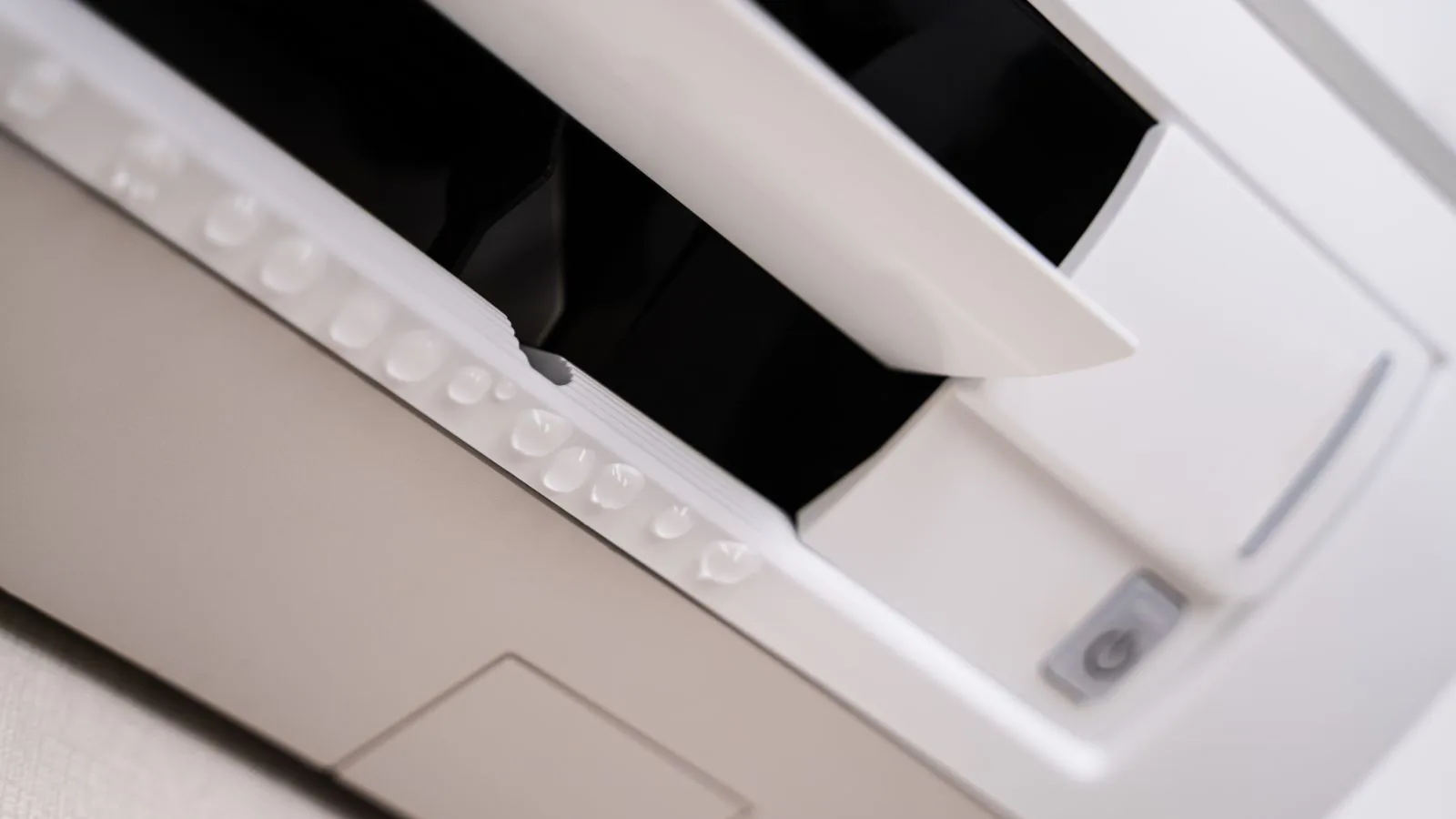
AC leak water damage in Seaford, NY is moisture damage to ceilings, walls, floors and insulation caused by condensate that escaped from an air conditioner or heat pump. During cooling, the evaporator coil pulls roughly a few gallons of water out of the air on a hot day, and that water is meant to leave through a drain line. When the path fails, the water goes into whatever is below.
Signs your AC is leaking where you cannot see it
The visible drip at the unit is the easy case. The harder one is a hidden leak inside a closet, soffit or attic, where water soaks insulation and framing for weeks before a stain appears.
- A yellow or brown ring on the ceiling under an attic air handler or near a return vent.
- Water in the secondary drain pan, or a float switch that keeps shutting the system off.
- Musty smell in the closet housing the unit, or soft, discolored drywall at its base.
- Ice on the refrigerant line or coil, followed by a puddle when it thaws.
- Cabinet or flooring edges swelling in a hallway with the air handler overhead.
Safety checklist before you touch anything
- Turn the thermostat to off so the system stops making more condensate.
- Do not touch wet wiring or the air handler disconnect with wet hands. Cut power only from a dry panel you can reach safely.
- Avoid standing under a bulging or dripping ceiling, since a wet drywall panel can drop without warning.
- Call 911 for any burning smell, sparking or gas odor before you call the restoration line.
Seeing a stain below the air handler or drips from a vent? Call the dispatch line and describe where it shows up.
Call (516) 845-9582Why condensate lines clog and pans overflow
The drain line carries cold, dirty water that grows a film of algae and slime inside the pipe. Over a cooling season the film builds into a plug, the primary pan fills, and the overflow runs into the ceiling or floor. A frozen coil does the same thing in a different way, since the ice melts faster than the line can carry it.
Rusted steel pans crack after years of standing water, and a dirty air filter lowers airflow enough to freeze the coil. A technician can clear the line, test the float switch and fix airflow. Water that has already escaped is our part.
How we assess and dry an AC leak
A moisture meter and thermal imaging camera map the wet drywall, insulation and framing around the air handler. In an attic, the ceiling below usually shows more water than the stain suggests, because insulation holds water against the drywall like a sponge.
Wet insulation is typically removed. Drywall that is only damp can dry in place with air movers and an LGR dehumidifier, which pulls moisture from the air faster than a household unit. Daily moisture readings show whether the cavity is drying, and the ANSI/IICRC S500 standard sets the framework for those checks.
Where the leak sits decides the work
The same clogged line causes very different jobs depending on where the unit is installed.
| Air handler location | Where water goes | Typical response |
|---|---|---|
| Attic | Insulation, then ceiling drywall below | Remove wet insulation, dry framing, repair ceiling. See ceiling water damage repair |
| Closet or utility room | Floor, baseboards, wall base | Extraction, then air movers behind the baseboard |
| Basement | Concrete, stored items, finished wall bases | Extract, dry, move contents. See basement water damage cleanup |
| Roof or exterior unit | Pad, wall penetration, siding line | Locate the entry point first, then dry the wall cavity |
Dry it, replace it, or both
Condensate water is usually clean at the moment it leaks, but it picks up slime and dust from the pan. Long exposure moves it toward Category 2, which changes what can be saved. Caught in days, drywall and insulation often dry in place. Caught after weeks, the paper face of the drywall may be stained or soft, and removal is cheaper than trying to save it.
Mold can show up on drywall that stayed damp. Treat visible growth as a separate job. See mold remediation for how containment and removal are handled.
What sets the price of AC leak cleanup
The price follows the area that is wet and how long it stayed that way. A small closet floor is a short drying job. An attic with soaked insulation and a stained ceiling below involves removal, drying and rebuild.
Water category, material type, drying days, equipment count and finish work such as texture and paint all play in. Scope and price are explained before work starts, and a call gives a real number once we know where the unit sits.
A general note on insurance
Insurers often treat a sudden overflow differently from a leak that went on for months. Gradual or neglected damage is often excluded, so the date you first noticed the stain matters. Check your policy wording and ask your insurer how it treats HVAC leaks.
Photograph the pan, the drain line and the stain before cleanup, as NY DFS advises. No one can promise a claim will be accepted.
What we do not do
We do not service air conditioners, recharge refrigerant, replace coils or unclog condensate lines. Call an HVAC technician for that. Ask the Town of Hempstead Department of Buildings whether replacing the unit in your house calls for a permit.
Restoration is the drying and repair of what the water touched, and drying is pointless if the line plugs up again next week. Have the drain fixed in the same visit window.
A note for Seaford homeowners
Census figures put Seaford's owner-occupied rate at 92.9%, so most readers own the unit, the ceiling and the repair bill. Before cooling season, pour a cup of vinegar or ask your HVAC tech to flush the drain line and check the float switch.
If a stain is already on the ceiling, mark its edge with a pencil and watch whether it grows. New York's mold licensing law covers projects over 10 square feet, so a larger area may need a licensed contractor. See our service area page for the towns we cover, and the structural drying and dehumidification page for how drying works.
Frequently asked questions
Why is water dripping from my air conditioner?
The usual cause is a clogged condensate drain line, which sends water to the overflow pan and then onto the ceiling or floor. A frozen coil or a cracked pan can do the same. Switch the system off at the thermostat and have an HVAC technician clear the line.
Is AC condensate water dangerous?
It is not sewage, but it can carry algae, dust and slime from the coil and pan. Avoid touching it with bare hands if it sat for days. Questions about health effects belong with a physician, and a restoration crew can handle wet materials safely.
Can wet insulation above my ceiling be dried?
Fiberglass batts that are only damp can sometimes dry, but compressed or soaked insulation usually comes out. It holds water against the drywall below. A moisture meter and thermal imaging camera show how far the wet zone runs.
How long does drying take after an AC leak?
Small closet and floor leaks may need 2 to 3 days of air movers and dehumidifiers. Attic and ceiling jobs run longer when insulation and framing are involved. We read moisture levels at each visit and share the numbers.
Do I need to turn the AC off?
Yes, while water is escaping. Shutting it off at the thermostat stops condensate production, and cutting the breaker also removes power if the unit sits in wet areas. Leave the breaker alone if the panel is wet. Then call an HVAC tech and our dispatch line.
Can I get help with AC leaks in Seaford right away?
The dispatch line is a good first call if a ceiling is sagging. For slower seepage, scheduling is calmer. Either way, scope and price are explained before drying equipment is set up.
Call to have the wet area measured and the drying plan explained, including scope and price, before any equipment arrives.
Call (516) 845-9582